 Milometry
Driving to the airport for a work trip: what you can claim
The drive to the airport, the parking while you are away and the hire car at the other end are all treated differently. Here is how each one works.

General information, not advice. Written as general information and correct as far as we know on 27 September 2026. Tax rules change, and how they apply depends on your own circumstances. This is not tax, legal or financial advice: check with an accountant, a tax adviser or HMRC before you rely on it.
A work trip that involves a flight usually starts and ends with a drive. It is one of the most commonly forgotten claims, partly because the flight feels like the business part and the drive feels like getting to it. HMRC does not see it that way. If the trip is for work, the drive to the airport is part of the business journey, and so is the parking while you are away.
The drive is part of the journey
For employees, travel to a temporary workplace is business travel, and the whole journey counts, not just the final leg. A client meeting in Dublin, a conference in Amsterdam or a site visit in Aberdeen are all temporary workplaces for most people. The drive from home to the airport is the first leg of getting there, and the drive home from the airport is the last leg of getting back.
That means both directions go in the log. The return trip is the one people forget, because it happens at the end of a long day when nobody is thinking about expenses.
At the current approved rate, the approved amount for a car or van is 55p a mile for the first 10,000 business miles in the tax year, then 25p. A 60-mile drive to the airport and back is 120 miles, which is £66 at 55p. Do that for a handful of trips a year and it adds up to more than most people expect.
| Vehicle | First 10,000 business miles | Above 10,000 |
|---|---|---|
| Cars and vans | 55p per mile | 25p per mile |
| Motorcycles | 24p per mile | 24p per mile |
| Bicycles | 20p per mile | 20p per mile |
Home or office: which start point counts
If you drive straight from home to the airport, the claim runs from home. If you go into the office first and then leave for the airport, the leg from home to the office is still ordinary commuting and only the office to airport leg is business travel.
There is one trap. If the journey to the airport is substantially the same as your normal commute, for example the airport sits just beyond your usual office on the same road, HMRC can treat it as ordinary commuting. For most people the airport is in a different direction or a lot further away, so this rarely bites, but it is worth knowing the rule exists.
Parking while you are away
Airport parking for a business trip is a cost of the business journey. An employer can reimburse it tax free, and if you are self-employed you can claim it on top of the flat mileage rate, because the simplified rate covers the cost of running the car, not the cost of leaving it somewhere.
Keep the booking confirmation. Airport parking is often booked weeks in advance, paid on a personal card and then forgotten, and the confirmation email is the receipt.
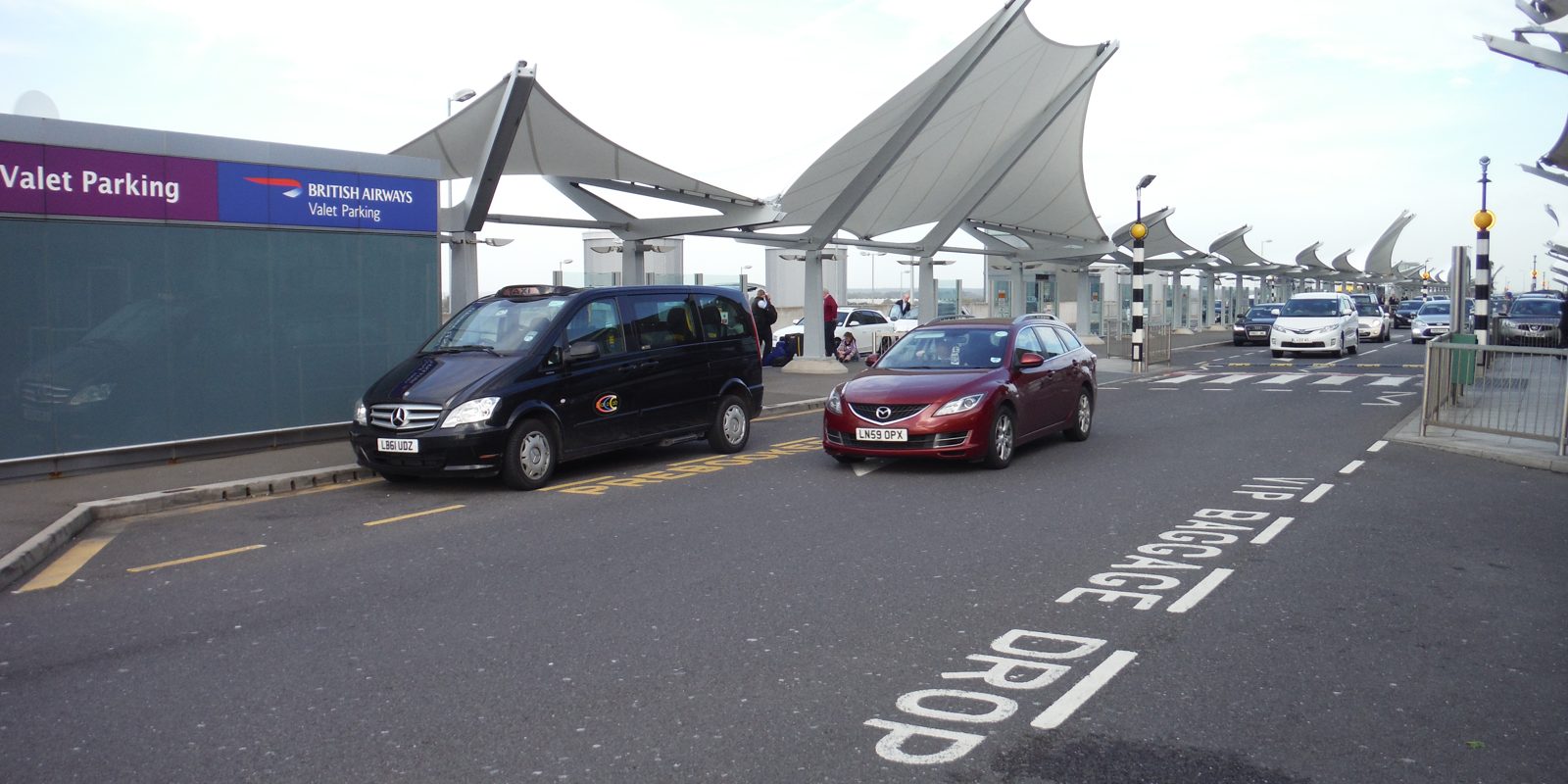
The same applies to tolls on the way. A Dart Charge on the drive to Gatwick or Stansted for a business trip is a business cost. A parking fine picked up at the terminal drop-off zone is not: penalties are never an allowable expense, however work related the journey was.
Being dropped off
If someone drops you at the airport, the arithmetic changes. Your employer's mileage rate is for journeys you make in your own vehicle, and a drop-off doubles the driving, because the car has to come back empty and then come out again to collect you. Some employers will pay for it, many will prefer you take a taxi or park, and a few have a specific policy for it. Check before you assume, and if you do claim, record who drove and why.
The hire car at the other end
Once you land, what you claim depends on who pays for the hire car. If your employer hires it, or reimburses the hire charge and the fuel as actual costs, then those actual costs are what is claimed, not a rate per mile. Keep the hire agreement and the fuel receipts, and do not also log those miles at the mileage rate, because the two claims would overlap.
If you hire a car yourself and are paid mileage for it instead, the approved rates can apply: they cover any car or van that is not a company vehicle, not only one you own. The miles you drive on either side of the flight count towards your 10,000-mile threshold, and so do hire-car miles paid at the mileage rate. Miles claimed as actual hire and fuel costs do not.
When the trip is partly a holiday
Plenty of people add a few days of their own to a work trip. For employees, if the trip is mainly for business and the personal part is incidental, the travel to and from the airport generally stays claimable, and the extra personal days are your own cost.
For the self-employed, the test is stricter. Expenses have to be incurred wholly and exclusively for the business, and a trip with a genuine dual purpose, business and holiday in roughly equal measure, can lose relief altogether. If the holiday is the real reason for going, the drive to the airport is a holiday drive.
What to record
The drive itself is easy to capture. The detail that makes it a claim is the purpose, and for airport runs the purpose is the trip, not the airport.
| Field | Example |
|---|---|
| Date | 14 October 2026 |
| From | Home |
| To | Manchester Airport |
| Purpose | Flight to Dublin, client workshop at Acme Ltd |
| Distance | 58.2 mi |
| Parking | Seven days, booking reference kept |
"Airport" on its own tells nobody anything. "Flight to Dublin, client workshop" answers the question HMRC would actually ask, and it links the drive to the rest of the trip's expenses. Milometry records the date, route and distance automatically, so the only part you add is the reason, ideally before you board, when it is still obvious.
Sources
- 490: Tax and National Insurance contributions for employee travel (HMRC)
- Business journeys: tax relief (490 chapter 5) (HMRC)
- Employment Income Manual EIM31240: approved mileage allowance payments (HMRC)
- Business travel mileage for employees' own vehicles (HMRC)
- Simplified expenses if you're self-employed: vehicles (HMRC)
Related reading: What actually counts as a business mile? and Parking, tolls and charges: what else you can claim.
General information for UK drivers, not legal or tax advice. If your situation is unusual, particularly around mixed business and personal trips, take proper advice.